

While on a short-term mission trip to North Africa with AFM during the fall of 2022, we were encouraged by the rector of our host church to explore further south where the population is primarily composed of the Berber people group. There was something there he wanted us to discover, and we saw the twinkle in his eye! We traveled away from the heavily populated Mediterranean coast, through hours of olive groves and ancient Roman ruins. The further south we went, the more arid, barren, and sparsely populated it became. Donkey carts and camels became more and more common.
Berbers live throughout North Africa in Morocco, Algeria, Tunisia, Libya, and as far east as Egypt. They also live as far south as Mauritania, northern Mali, and northern Niger. Deserts and mountains have separated this people group into regions which lack a common language and common customs. The region we visited was on the edge of the arid Sahara and was totally Muslim.
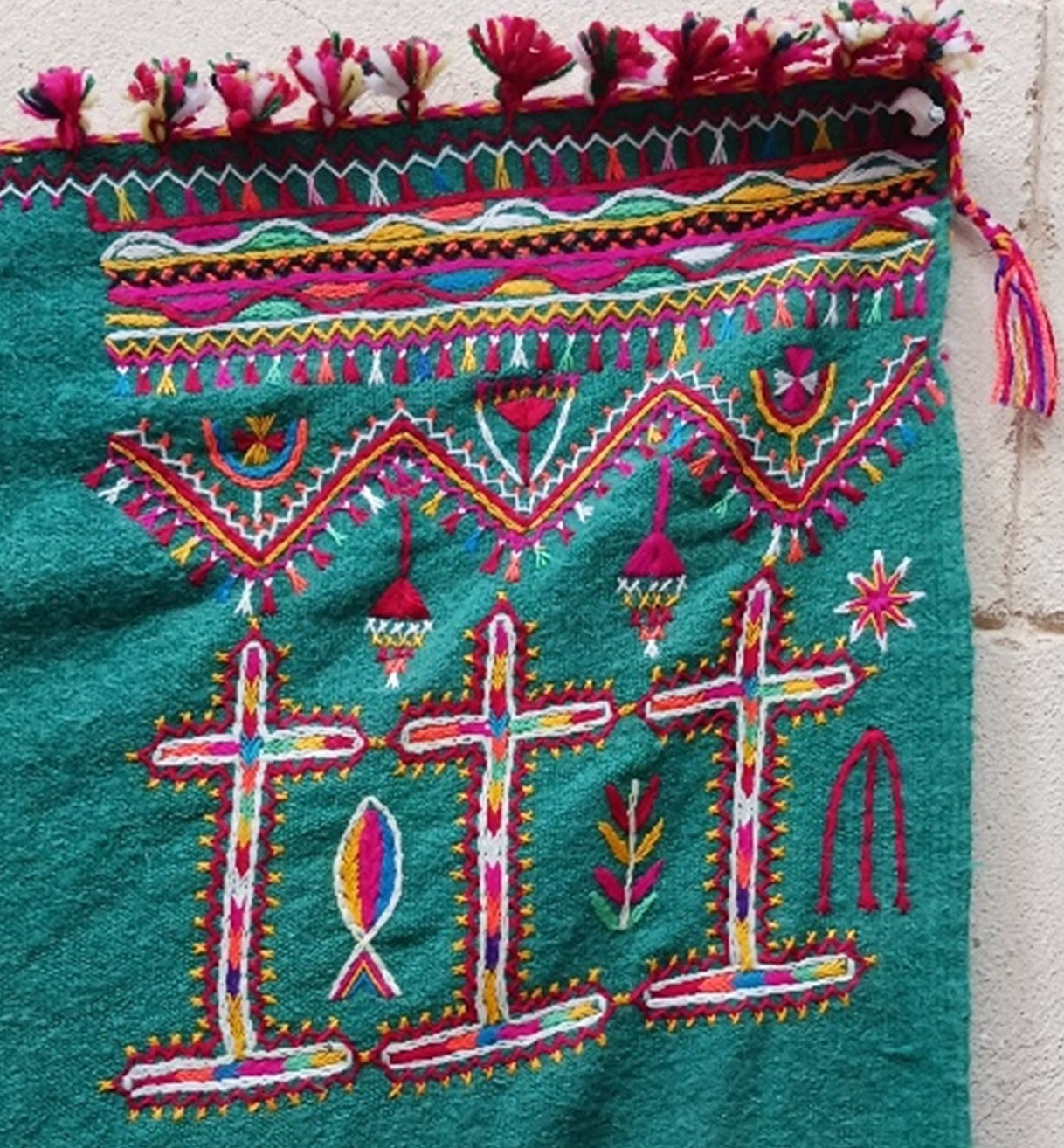 It was here that we entered a small, rarely-visited, and off-the-beaten-path Berber museum in which their history and traditions have been preserved in an underground dwelling. (These underground homes provide protection from the excessive heat of the summer and the cold of the winter, and in ancient times from raiders.) The museum curator greeted us warmly, eager to share with us the history and customs of his people. Knowing we were Christians, he was also pleased to share with us the Christian history of his people. He seemed in no way ashamed of this history.
Though these people are not currently Christian, we were shocked and thrilled to find tendrils of the Gospel still present among the Berbers. The people in this particular Berber village record their religious history on their wedding textiles, woven by the bride’s family and embroidered by the groom’s family. They include symbols of animism, Judaism, Christianity, and Islam. The most prominent symbols are Christian ones: three crosses, a fish (in Greek, Ichthus. The letters Ichthus of stand for “Jesus, God’s Son, Savior”), a palm frond for Palm Sunday, and three Vs for the persons of the Trinity.
As we now prepare to become long-term cross-cultural workers with AFM in the same region in which we saw these wedding textiles, we’re so encouraged to know that God has already gone before us! Just as we saw Him at work among the Berber people last summer, we know that God’s Spirit is moving among all unreached people groups today. The tendrils of the Gospel are already there, waiting to be shared and explained . . . if only someone will go.
“Here I am! Send me!” In May I stepped down as rector from the church in which I served for 25 years. For my parishioners, the precious saints whom my wife and I have loved and served, this is a bitter-sweet time. They are already missing us…and we them! Yet, so many have said, “I saw this coming,” or “God’s in this,” or “How can we stand in the way of reaching an unreached people group?” I’ve been comforted to hear these words from my former parishioners, who are now committed senders and supporters of our missionary call.
Throughout the summer and early fall, we will complete our training and financial support-raising. God willing, we’ll launch into full-time cross-cultural work in North Africa by November 2023!
But we could not have done this alone. The AFM team has not only prayed for us, but also guided, supported, equipped, trained, and cared for us. They’ve helped us create an entry strategy into our country of service. Their pastoral team has been attentive to our emotional, familial, and spiritual needs every step of the way. We’re so thankful for what they do!
Though not all are called to go overseas, all are called to participate in Jesus’ Great Commission (Mt. 28:18-20). Accordingly, I warmly invite you to give to this year’s annual Barnabas Offering, so that cross-cultural workers like my wife and I can share Jesus’ love among people groups without viable, visible, or self-sustaining churches, that the tendrils of the gospel might take deep root among all unreached peoples.
Praise be to God; the seeds have already been planted in North Africa. The tendrils are already there!
To give to this year’s Barnabas Offering, click here.
To learn more about “William” and his wife “Mimi’s” calling in North Africa, you can email them at saharasojourn@gmail.com.